In the Middle Ages, there were already ‘grocers’ who travelled and sold at markets. With their herbs, they also acted as druggists and pharmacies . With the opening of the trade route to India, colonial goods were added. The traveling merchants were gradually replaced by permanent shops. From the Middle Ages until the end of the 18th century, grocers united in their own guild: the St. Nicholas Guild. During the French occupation in 1798, all guilds were abolished. This cleared the way for grocers to evolve into a more general food retail business.
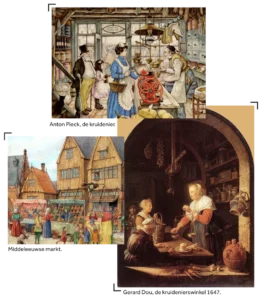
Grocers in the 19th century were small independent entrepreneurs. By the end of this century, major changes were on the horizon. Most importantly, branded products were born. As a result, many new products were introduced. Forward-thinking retailers started chain stores outside of wholesale operations: department store chains. The labour movement established cooperative consumer associations, where members could buy groceries at lower prices: co-op. Independent grocers started looking for new forms of cooperation, such as purchasing associations and voluntary chain stores.
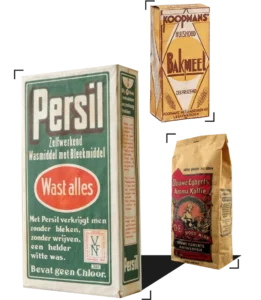
By the end of the 19th century, the range of products underwent significant changes as more and more factory-produced goods entered the market. These
included baby food, macaroni, cornstarch, custard, oatmeal, bouillon cubes, syrups, peanut butter, chocolate sprinkles, toothpaste, and soap.
In short, the prepackaged (branded) product was born. The grocery store definitively took on a new appearance. In addition to the ever-expanding product ranges, the presentation of the products and the decoration of the stores also began to play a role. After all, seeing leads to buying.
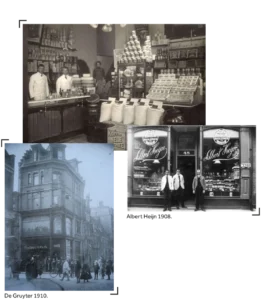
At the end of the 19th century, department store chains emerged. Famous names include De Gruyter, Simon de Wit, and Albert Heijn. These were major entrepreneurs with multiple branches who started purchasing and producing on their own. Private labels made their debut.
Albert Heijn, who started with a small 12 m² store in Oostzaan in 1887, had ten stores by 1902. De Gruyter’s decline came in the 1960s because it missed the transition to modern supermarkets. By the late 1970s, the stores had gradually disappeared from the streets, as had Simon de Wit, which was taken over by Albert Heijn. Edah, founded in 1910, also had to close its doors in the early 21st century.
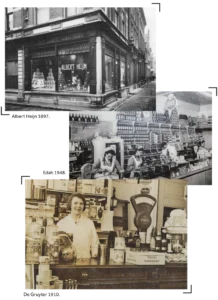
To buy goods more cheaply, independent shopkeepers also began to cooperate. Around 1900, the first retailer purchasing associations emerged. In 1928, several of these purchasing associations united in the Sperwer alliance. Others joined in. Since 2001, they have operated under the name Plus. Other grocers collaborated in voluntary chain stores. In 1932, in Zevenhuizen (ZH), Grossierderij Van Well founded the first voluntary chain store in the world: De Spar. In this organization, wholesalers and retailers worked together. Spar is now active in 49 countries. Well-known chains included Centra, Vivo, Végé, A & O, and Kroon. One of the founders of Kroon in 1921 was Grossierderij Van Eerdt from Veghel, which is now the current owner of Jumbo.
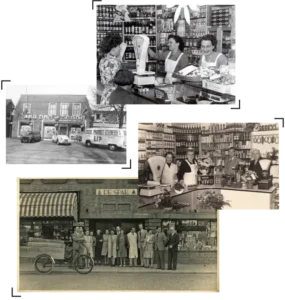
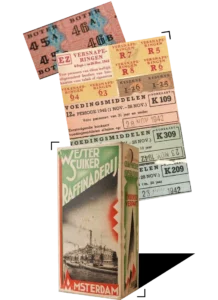
Under the threat of World War II, sugar was the first item to be rationed in 1939. During the occupation, more and more items were rationed, such as bread, butter, cheese, eggs, cookies, detergents, meat, flour, and tea. To purchase these products, one needed ration coupons. This gave grocers a lot of extra work. The coupons had to be checked, administered, pasted, and submitted to distribution offices. If everything was correct, they would receive new supplies. The increasing scarcity of products like coffee, tea, soap, and bread led to many substitute products. Coffee was the last item to come off rationing in 1952.